Provider review
A licensed provider reads your health intake, including eye history, and decides if bimatoprost is right for you.
Eyelash care, by prescription
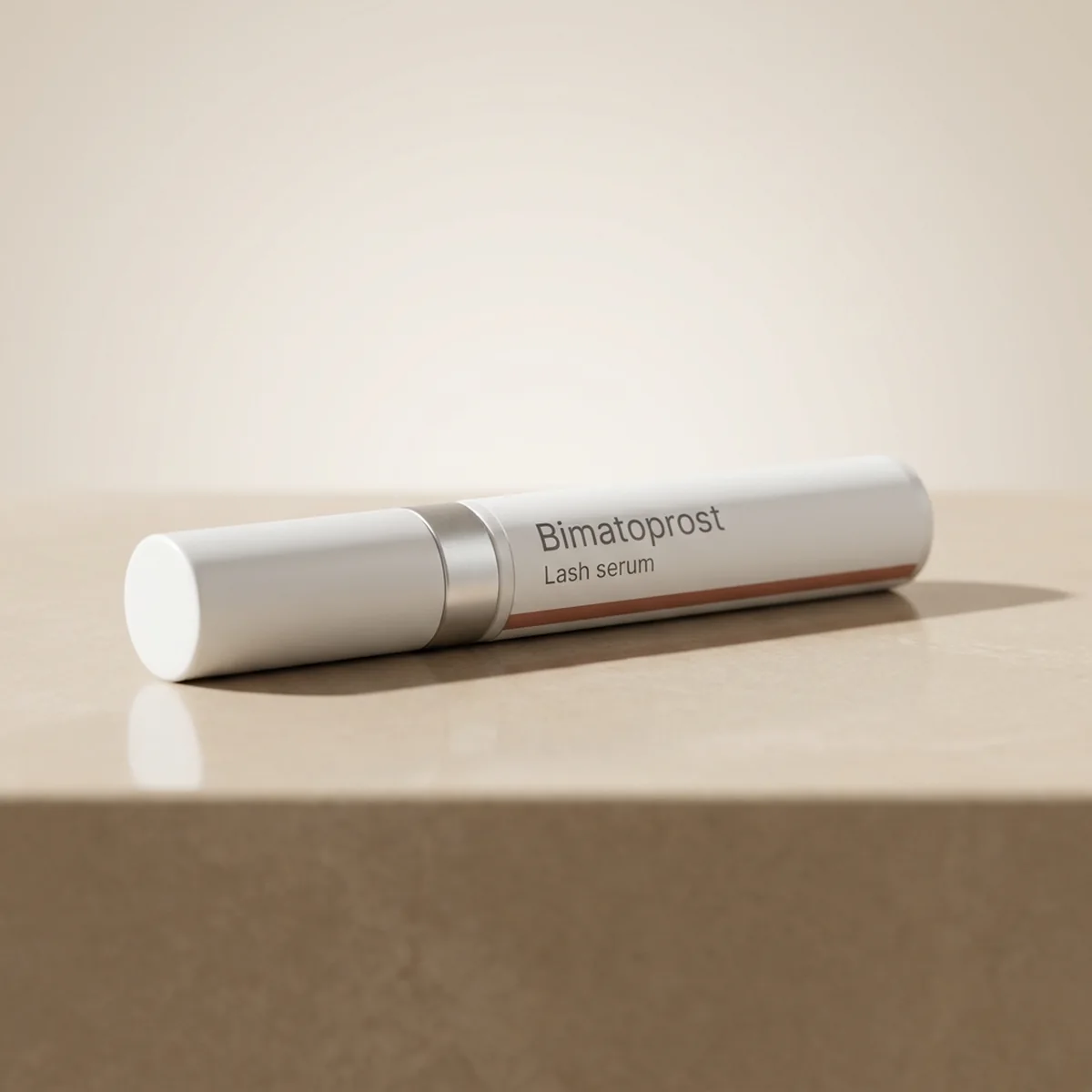
Compounded bimatoprost 0.03% lash serum, after a licensed provider's review. A licensed 503A compounding pharmacy prepares your order and ships it free.
From $164/mo with the 12-month plan and auto-refill
How would you like to pay?
Choose your plan
Prescription treatment requires an online medical evaluation. A provider decides whether treatment is appropriate; approval is not guaranteed.
Product details
Your plan
A licensed provider reads your health intake, including eye history, and decides if bimatoprost is right for you.
Bimatoprost 0.03% lash serum, prepared by a licensed compounding pharmacy after approval.
Delivered to your door at no added cost.
Pay once, or turn on auto-refill and take 10% off. Change or cancel refills anytime.
A printable decision pack and a plain checklist for reading a study.
Help with your order and delivery when you need it.
How it works
Pick 1, 3, 6 or 12 months. Auto-refill takes 10% off each plan.
Answer a private online questionnaire, including your eye history. A licensed provider reviews it.
If prescribed, the pharmacy prepares your order and ships it to you free.
Why people choose it
Each card links to the original study, with a tag for the kind of evidence behind it.
The Latisse label says it is a prostaglandin analog indicated to treat hypotrichosis of the eyelashes by increasing their growth including length, thickness and darkness. It says to apply nightly directly to the skin of the upper eyelid margin at the base of the eyelashes.
Read the study Controlled human trialIn a 2012 randomized trial, 78.1% of subjects treated with bimatoprost 0.03% versus 18.4% on vehicle demonstrated at least a 1-grade increase in global eyelash assessment score at week 16. The abstract lists the short duration of the trial as a limitation.
Read the study Approved labelThe Latisse label's iris pigmentation warning states that increased iris pigmentation has occurred when bimatoprost solution was administered and that the brown iris pigmentation is likely to be permanent.
Read the study Approved labelThe Latisse label says that upon discontinuation of treatment, eyelash growth is expected to return to its pre-treatment level, and the patient information says the eyelashes are expected to return to their previous appearance over several weeks to months.
Read the studyThe honest version
Trials measured eyelash growth and also recorded eye and skin effects. Here is what the sources say, including their limits.
See every study we trackIn a 2012 randomized trial, subjects were randomized over 5 months to once-daily bimatoprost 0.03% (n = 137) or vehicle (n = 141). A higher percentage of subjects treated with bimatoprost 0.03% (78.1%) than vehicle (18.4%) demonstrated at least a 1-grade increase in global eyelash assessment score at week 16 (P < .0001). The abstract lists the short-term duration of the trial and that black subjects were not enrolled secondary to technical requirements of digital image analysis as limitations.
SourceA 2015 randomized controlled trial in patients with idiopathic hypotrichosis reports that treatment effects were maintained for approximately 2 months but markedly diminished 4-6 months following treatment cessation.
SourceA pooled safety analysis of six randomized trials reports that most adverse events occurred early in treatment, were mild in intensity, localized to treatment site, and reversible with treatment cessation, and that discontinuations due to adverse events were low (3.2% for bimatoprost and 2.4% for vehicle).
SourceA literature review published in Dermatologic Surgery (2021) states that the literature pertaining to bimatoprost for treatment of eyelash hypotrichosis is dominated by industry-sponsored clinical trials. It concludes that clinical trials may have systematically underreported the incidence of drug application discomfort and prostaglandin-associated periorbitopathy, and that the risk of increased iris pigmentation remains inadequately investigated.
SourceAn observational retrospective chart review of bimatoprost 0.03% found that 27.4% of patients spontaneously recalled experiencing adverse events while on treatment, only 4 adverse events were documented in patient charts, no instances of iris hyperpigmentation occurred, and no serious or severe adverse events were noted. Its author affiliations include Allergan, Inc.
SourceThe FDA says compounded drugs are not FDA approved, which means the agency does not review their safety, effectiveness or quality before they are marketed.
SourceFAQ
The things people ask most before starting Bimatoprost lash serum.
Compounded bimatoprost 0.03% lash serum for short or sparse eyelashes, after a licensed provider's review. A licensed 503A compounding pharmacy prepares your order and ships it free.
Bimatoprost lash serum paid once: $229 for 1 month, $618 for 3 months, $1,168 for 6 months or $2,198 for 12 months. With auto-refill each is 10% off: $206, $556, $1,051 and $1,978 ($164.83 a month on the 12-month plan). Shipping is free, and the exact total is shown before you pay.
Yes. You complete an online health intake, including your eye history, and a licensed provider decides whether bimatoprost is right for you. Choosing a plan does not guarantee a prescription.
Bimatoprost 0.03% is an FDA-approved drug as Latisse: Drugs@FDA lists LATISSE as bimatoprost 0.03% solution/drops for topical use by prescription, with an ORIG-1 action dated 12/24/2008. The serum sold here is compounded by a licensed 503A pharmacy. FDA says compounded drugs are not FDA approved, which means the agency does not review their safety, effectiveness or quality before they are marketed. The label and trial results on this site come from the approved product.
The Latisse FDA label says the precise mechanism of action is unknown and that the growth of eyelashes is believed to occur by increasing the percent of hairs in, and the duration of, the anagen or growth phase.
The Latisse label says to apply nightly directly to the skin of the upper eyelid margin at the base of the eyelashes, to blot any excess solution beyond the eyelid margin, and to use a new sterile applicator for each eyelid. It says not to apply in the eye or to the lower lid, and that contact lenses should be removed before application and may be reinserted 15 minutes later. Your provider and pharmacy label give the directions for your serum.
The Latisse label's patient counseling section says the onset of effect is gradual but is not significant in the majority of patients until 2 months. The label says that upon discontinuation of treatment, eyelash growth is expected to return to its pre-treatment level, and its patient information says the eyelashes are expected to return to their previous appearance over several weeks to months.
The Latisse label lists eye pruritus, conjunctival hyperemia, skin hyperpigmentation, ocular irritation, dry eye symptoms and periorbital erythema among the most frequently reported adverse reactions in its clinical trial. Its postmarketing section lists periorbital and lid changes associated with periorbital fat atrophy and skin tightness resulting in deepening of eyelid sulcus and eyelid ptosis, and says these reports are voluntary from a population of uncertain size, so it is not always possible to reliably estimate their frequency or establish a causal relationship. Your provider explains what applies to you.
The Latisse label says increased iris pigmentation has occurred when bimatoprost solution was administered and that the brown iris pigmentation is likely to be permanent. It says iris color changes may not be noticeable for several months to years. In an observational retrospective chart review of cutaneous application, with the concentration not stated, no iris pigmentation change was noted.
The Latisse label's patient counseling section says the product may lower intraocular pressure although not to a level that will cause clinical harm, and that patients using prostaglandin analogs for IOP reduction should only use it after consulting with their physician and should be monitored for changes to their intraocular pressure. The patient information says that if you have a history of abnormal IOP, you should only use it under the close supervision of your physician.
The Latisse label's pregnancy section states that the 0.03% product should be administered during pregnancy only if the potential benefit justifies the potential risk to the fetus, and says there are no adequate and well-controlled studies in pregnant women. It says it is not known whether topical ocular treatment could result in sufficient systemic absorption to produce detectable quantities in human milk.
The FDA says section 503A of the FD&C Act describes the conditions under which compounded human drug products are exempt from the FD&C Act sections on FDA approval prior to marketing, current good manufacturing practice (CGMP) requirements, and labeling with adequate directions for use. One of the section 503A conditions is that the drugs must be compounded based on the receipt of valid patient-specific prescriptions. FDA also says compounded drugs are not FDA approved.
No. You can pay once for 1, 3, 6 or 12 months, or turn on auto-refill and take 10% off. You can change or cancel refills anytime.